
A crossbite means some upper teeth close inside the lower teeth instead of just outside them. It can affect back teeth, front teeth or both. Most crossbites come from a narrow upper jaw or crowding, and orthodontic treatment corrects them at almost any age.
What is a crossbite, exactly?
In a healthy bite, the upper arch is slightly wider than the lower arch. When you close, the upper teeth rest just outside the lower teeth all the way around, a little like a lid sitting over a box. A crossbite is any spot where that relationship flips and an upper tooth lands behind or inside its lower partner.
It can involve a single tooth or a whole side of the mouth. Some people have never noticed theirs because it causes no pain, while others feel their jaw slide to one side every time they bite down. Either way, it is a bite problem rather than a purely cosmetic one, which is why orthodontists pay close attention to it.
Posterior crossbite
A posterior crossbite involves the back teeth. One or more upper molars or premolars close inside the lower ones, on one side or on both. It usually points to an upper jaw that is narrower than the lower jaw. When only one side is affected, the lower jaw often shifts sideways to find a comfortable place to close, which can make the chin look slightly off-center.
Anterior crossbite
An anterior crossbite involves the front teeth. One or more upper front teeth sit behind the lower front teeth when you bite. When all of the front teeth are involved and the lower jaw sits well forward, the problem is usually described as an underbite, which is a related but more skeletal pattern.
What causes a crossbite?
Most crossbites have more than one contributor. The common threads are the size of the jaws, the amount of room for teeth and the habits that shape a growing mouth.
Jaw width and growth
A narrow upper jaw, called the maxilla, is the most frequent cause of a back-teeth crossbite. If the upper arch does not grow as wide as the lower one, the teeth cannot line up correctly no matter how straight they are individually. Jaw size tends to run in families, so a parent's bite can be a useful clue.
Crowding and tooth position
When there is not enough room, a tooth may erupt behind its neighbors or tip inward. A single front tooth that comes in behind the lower teeth is a classic example. Baby teeth that stay too long or are lost too early can also steer adult teeth off course.
Habits and breathing
Long-term thumb or pacifier sucking, a low tongue posture and chronic mouth breathing can all influence how the upper jaw develops. A tongue that rests low in the mouth does not push outward on the palate the way it does during nasal breathing, which is one reason Gellerman Orthodontics looks at airway and breathing as part of every evaluation.
How do you know if you or your child has a crossbite?
Some crossbites are easy to spot in the mirror. Others are only obvious once an orthodontist watches how the teeth come together. Signs worth mentioning at an exam include:
- Upper teeth that disappear behind lower teeth when biting down
- A jaw that slides to one side or forward before the teeth fully close
- A chin or smile that looks off-center
- Uneven wear, chips or notches on specific teeth
- Gum recession around a tooth that takes more force than its neighbors
- Jaw soreness, clicking or tired chewing muscles
- Snoring, mouth breathing or restless sleep in children
For kids, the timing of that first look matters. Dr. Gellerman recommends an orthodontic evaluation at around age 7, when a mix of baby and adult teeth makes jaw-width problems easier to see and easier to guide.
Why should a crossbite be treated?
A crossbite rarely fixes itself. Leaving it alone does not usually cause sudden trouble, but it keeps stressing the teeth, gums and jaw in ways that add up.
Uneven wear and gum stress
Teeth caught in a crossbite take forces at angles they were not built for. Over time that can wear enamel unevenly, chip edges and push the gum line back on the teeth that bear the load.
Jaw shifting and asymmetric growth
A child who shifts the lower jaw to one side every time they bite is training that jaw to grow in a shifted position. Correcting the width early lets the jaw close straight and develop more evenly.
Breathing and sleep
Because a narrow upper jaw also forms the floor of the nose, widening it can create more room for nasal breathing. The palatal expander page notes that expansion can open the nasal airway and support healthy nasal breathing in growing children.
How is a crossbite treated in children?
Children have an advantage. The two halves of the upper jaw are joined by a growth seam that has not fused yet, so the jaw can be widened gently without surgery.
Palatal expanders
A palatal expander is the go-to tool for a back-teeth crossbite in a growing child. It fits on the upper molars and has a small central screw that parents turn at home with a special key, usually once or twice a day. The active widening takes a few weeks, and then the appliance stays in place for several months while new bone fills in and stabilizes.
Mild pressure after a turn, a little extra saliva and a small gap opening between the front teeth are all normal. The appliance care instructions cover cleaning, soft foods for the first few days and what to do if a turn is missed.
Two-phase treatment
Expansion is often the first step of two-phase orthodontic treatment. Phase one corrects the jaw relationship and makes room for adult teeth. After a resting period while the remaining permanent teeth come in, phase two usually uses braces to put each tooth in its final position.
Facemask therapy for underbites
When an anterior crossbite is part of an underbite pattern, a facemask can encourage the upper jaw forward and downward. It is worn in the evenings and overnight, when the body does most of its daily growing.
How is a crossbite treated in adults?
After adolescence the growth seam in the palate fuses, so a standard expander no longer widens the jaw on its own. That does not mean adults are out of options.
- Braces or clear aligners: crossbites caused by tooth position rather than jaw width can often be corrected with braces or Invisalign clear aligners alone.
- MARPE: miniscrew-assisted palatal expansion anchors an expander to the palate with micro-screws so adult bone can be widened in the office, without general anesthesia or a hospital stay.
- Surgical orthodontics: when the jaws are significantly mismatched, braces combined with orthognathic surgery may be recommended once growth is complete.
Which crossbite treatment fits which situation?
Every plan starts with a diagnosis, but this overview shows how age and cause shape the usual options.
| Situation | Common approach | What to expect |
|---|---|---|
| Child with a narrow upper jaw | Palatal expander, often as phase one | Few weeks of turns, several months of stabilizing wear |
| Child with an underbite pattern | Facemask with an intraoral appliance | Evening and overnight wear during growth |
| Teen or adult with a tooth-level crossbite | Braces or Invisalign | Correction as part of full treatment |
| Adult with a narrow upper jaw | MARPE, then braces or aligners | In-office appliance, passive wear while bone heals |
| Adult with a major jaw mismatch | Braces plus orthognathic surgery | Hospital procedure after growth ends, about two weeks of rest |
What happens at a crossbite evaluation?
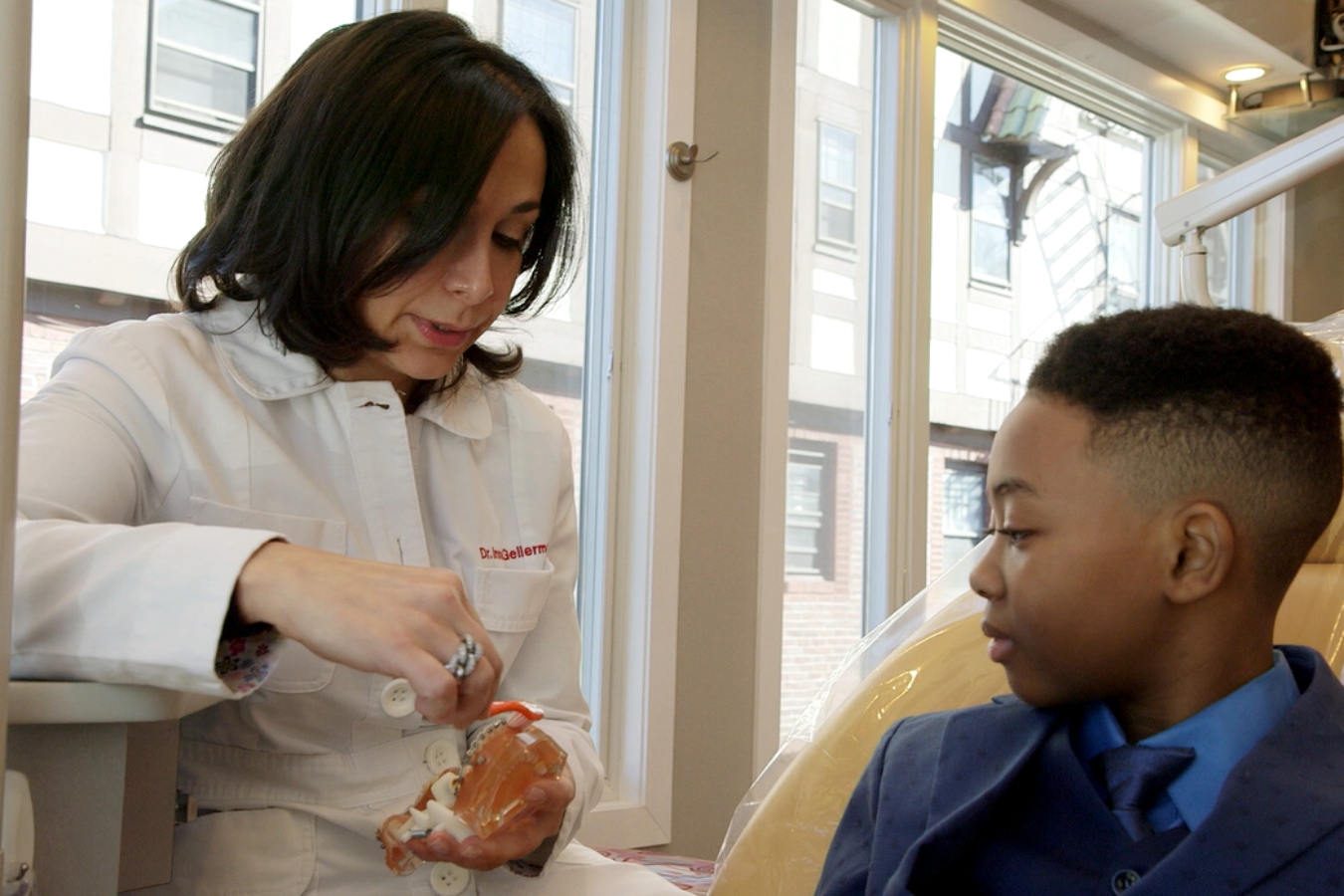
The goal of the first visit is to find out whether the problem is the teeth, the jaws or both. Dr. Gellerman examines the bite, watches how the jaw closes and reviews breathing and sleep habits.
Records typically include photos, X-rays and a digital model of the teeth. The practice uses an iTero scanner and iCAT 3D imaging so the bite, the jaw bones and the airway can all be seen in detail. From there, you get a clear plan, a sense of timing and an honest answer on whether treatment now or later makes more sense.
Crossbite FAQ
Can a crossbite correct itself?
Rarely. A baby tooth crossbite can occasionally resolve when adult teeth come in, but a narrow jaw does not widen on its own. An early exam is the best way to know which kind your child has.
Is crossbite treatment painful?
Most patients describe pressure rather than pain. Expanders cause brief tightness after each turn, and braces or aligners feel snug for a few days after adjustments or new trays.
How long does it take to fix a crossbite?
It depends on the cause. Expansion in a child is measured in months, while an adult crossbite corrected as part of full orthodontic treatment follows that treatment's overall timeline.
Can Invisalign fix a crossbite?
Often, yes, when the teeth rather than the jaw are the main issue. When the upper jaw itself is too narrow, aligners are usually paired with expansion first.
Get a clear answer on your bite
Whether you have noticed a shifted jaw in the mirror or a teacher mentioned your child's mouth breathing, a short evaluation settles the question. Contact Gellerman Orthodontics to schedule a visit and find out which crossbite treatment fits your stage of growth.